• Skip to primary navigation
  • Skip to main content

• John B Whalen Jr Esq •

• Probate • Wills • Estates •

Avvo Rated Superb 5.0
AV Peer Review Preeminent
Call Us•Email Us•Text Us

  • Home
    • About
    • Blog
    • Resume
  • Areas
    • Philadelphia Pa Accounts
    • Philadelphia Pa Estates
    • Philadelphia Pa Powers
    • Philadelphia Pa Taxes
    • Philadelphia Pa Wills
  • Archives
  • Contact
Home • Philadelphia Pa Attorneys Probate • Page 110

Philadelphia Pa Attorneys Probate

Pike County Pa Probate Lawyers

Pike County Pa Probate Lawyers – Intro

The Pike County Pa Probate process, itself, is a very simple process. However, it is merely the beginning of the Pa Estate Administration (Pa Estate Settlement) process, which involves settling a decedent’s affairs, and can (and does) involve many, many other steps, depending on many, many other things.

Pike County Pa Probate Lawyers – Definitions

In United States law and terminology, “probate” refers to proving that a will is valid. In many U.S. states, a person would petition the court for probate, and then add the will that is to be considered to their petition.

Once probate is approved by the court, the petitioner officially becomes the Executor and then has full legal rights to be able to deal with the deceased individual’s estate.

Pike County Pa Probate Lawyers – Misunderstandings

Although some states do have onerous Probate procedures (where “avoiding probate” may be a prudent strategy), Pennsylvania is not one of those states, In fact, Pennsylvania is very “Probate-Friendly.”

The most common misconception that surrounds a Pa Last Will is the process called “Probate” and the seemingly universal theme that it should be avoided at all costs. Again, and virtually to the contrary, the word “Probate” is merely based on the Latin infinitive verb that means “to prove.” Nothing more!

Pike County Pa Probate Lawyers – Register of Wills

You will need the following documents to probate a Pa Last Will in Pike County, PA.

  • Original Will
  • Original Death Certificate
  • Petition For Probate
  • Estate Information Sheet
  • Probate Fee

At the Register of Wills Office, the PA Executor will take an oath and be sworn in as the Executor to the estate. Furthermore, the executor will pay probate fees. These fees depend on the size of the PA Estate.

Pike County Pa Probate Lawyers – Short Certificates

A Short Certificate is a legal document that shows the decedent’s name and date of death. It will also show the name of the Executor/Executrix who has been named to handle the affairs of the estate.

  • Letters Testamentary (if the decedent had a Pa Last Will; or
  • Letters of Administration (if the decedent did not have a Pa Last Will

Having a Short Certificate indicates that one has been appointed by the Register of Wills and has been issued.

Pike County Pa Probate Lawyers – Register of Wills Office

The Information below is to assist you in locating the Luzerne County Pa Register of Wills in order to begin the Probate Process:

  • Pike County Pa Register of Wills
  • 506 Broad St # 108
  • Milford, PA 18337
  • Monday thru Friday 9:00 am to 4:30 pm.
  • (570) 296-3508

Pike County Pa Probate Lawyers – Executor Duties

To complete the process of settling an estate, I guide individuals throughout Pennsylvania through the Probate and Estate Administration with confidence and efficiency.

Getting court approval as executor/estate administrator and

  • Posting bond (if required)
  • Filing the Last Will with the appropriate probate court
  • Locating beneficiaries
  • Finding and assembling assets
  • Transferring assets from the deceased to the estate
  • Hiring valuation, genealogy or other experts, when appropriate
  • Paying creditors and claimants
  • Collecting amounts owed to the estate
  • Paying current and delinquent taxes as well as estate taxes
  • Distributing property to beneficiaries

Executors can easily make mistakes due to inexperience, stress and hasty decisions. This can be costly, as executors can be held personally liable for beneficiaries’ losses. I guide Pa Executors through every step of the probate process, with reliable, detailed advice, so you can settle the testator’s estate as efficiently, quickly and easily as possible.

Pike County Pa Probate Lawyers – Steps

The Pa Estate Settlement process can be long, and it’s often confusing. However, a solid checklist, can show that it’s not as complicated as you first thought. A timeline that details what to expect and when to expect it, you may find it’s actually not as complicated as you first thought.

Especially if you’ve been named as the Pa Executor, you need to understand the estate settling process. This will ensure that the estate is settled properly. This will help to show that all heirs receive their share of the estate. Use the following checklist to feel confident you’ve done everything you need, in this order, to properly settle an estate. 

  • Organize important information
  • Determine need for probate or attorney help
  • File the Will and notify necessary persons 
  • Take inventory and appraise all assets 
  • Set up a bank account 
  • Pay taxes 
  • Pay off any debts 
  • Distribute assets according to deceased person’s Will 
  • Close the estate 

1. Pike County Pa Probate Lawyers – Information  

The first step (and one of the most important ones) in the process of settling an estate is getting organized. You’ll want to keep track of both your expenses and all the time you spend working on settling the estate, as you’re entitled to be compensated. 

You should look for a Will. You’ll need access to several certified copies of the death certificate. You must notify financial institutions, including the bank, credit card companies and any investment firms. Be sure to inform the Social Security Administration, and know that you’ll need the deceased’s social security number to do so. Try to find a copy of the most current tax return, a birth certificate and any other important documentation. 

There are other, practical things to do, too. If you didn’t live with the deceased and there is now an empty property, you should secure it by changing the locks. You’ll want to take a detailed inventory of all his or her belongings. We’ll go more into detail about this below below, but you’re going to need to open a estate checking account. This will be in the estate’s name – you’ll be paying for things like final bills, court costs, potential lawyer’s fees and more from this account. 

Once you have these basic documents and tasks done, you should make one master list of contacts that includes all business associates and colleagues, anyone named in the Will, neighbors, friends, relatives and others. 

2. Pike County Pa Probate Lawyers – Probate or Attorney 

You may or may not need a lawyer. If an attorney is needed due to dispute, complexity or just for peace of mind, it’s important to remember that the process can become drastically more costly once attorneys are involved. To mitigate some of the cost, some opt to just hire an attorney to coach them along the way.

It was thought – in the past – that only the very wealthy had what’s known as “an estate.” The truth is, however, that even if you don’t have a 6 figure savings account or own a mansion, you likely do have an estate you’ll one day leave behind. And when that time comes, whether you’ve prepared for it or not, your estate will need to be settled. 

3. Pike County Pa Probate Lawyers – Notify Necessary Persons 

If there is a Will, it must be filed in the Register of Wills. The beneficiaries need to be notified. If there is a Trust, any successor trustees should also be informed. Other people to notify include: creditors/banks, the post office, the utility companies and any other business the deceased had accounts with. 

A smaller detail, but one that will ultimately need to be handled, includes canceling any subscriptions and notifying any agencies that were offering the deceased benefits (i.e. pension plans, etc). The last thing you want to have to be dealing with is returning payments that the estate was not entitled to. 

4. Pike County Pa Probate Lawyers – Inventory & Assets

Take inventory of all assets to see what needs to be distributed. You may want to have high value assets appraised. This will determine whether or not the Estate will owe any taxes. Remember that, as executor, it’s your responsibility to take care of the assets.

5. Pike County Pa Probate Lawyers – Estate Bank Account  

After you have what’s known as the Letters Testamentary (or Letters of Administration), you’ll want to set up an estate bank account. Use this account to collect money that may be owed to the deceased person. You can (and should) use this money to pay off any debts, and expenses.

6. Pike County Pa Probate Lawyers – Taxes 

File any necessary tax returns and ensure taxes are paid. You may need to file the following:

  • Federal Estate Tax (Form 706)
  • Pa Inheritance Tax (Form Rev 1500)
  • Gift and Generation-Skipping Transfer Tax (Form 709)
  • Estate and Income Tax (Form 1041)
  • Final Individual Income Taxes (Form 1040)

7. Pike County Pa Probate Lawyers – Debts

Even though the person who borrowed the debt is no longer living, their debts will still need to be paid off. Luckily, the estate (and not you personally) will pay the debts, so you don’t have to worry about anything other than figuring out what debts are owed to which companies.

Read more about what happens to debt after you die for additional, more detailed information about how to navigate this portion of the estate settlement. 

8. Pike County Pa Probate Lawyers – Distribute

After debts and taxes are paid, and if probate is closed (if the estate needed to go through the probate process), then you can distribute assets according to the deceased party’s final wishes. 

9. Pike County Pa Probate Lawyers – Close

Once all the above steps have been thoroughly completed, you can finally file a petition for discharge of executor responsibilities and ask the court to formally close the estate.

Pike County Pa Pa Probate Lawyers – Conclusion

I provide reliable guidance for Pa Testators and Pa Executors. My experience in the probate court, resolving issues related to the validity of wills, enables me to provide practical advice for testators from all walks of life. Similarly, my work in the formation of wills gives us keen insight into how executors should interpret various aspects of a will that may initially seem unclear.

Whether you are a testator formulating an estate plan or an executor implementing a decedent’s wishes, I can simplify many complex aspects of the tasks before you. I offer pertinent and personal legal advice to obtain the results you need in a timely manner with the least stress possible.

Related Posts

  • How Do You Settle A Philadelphia Pa Estate
  • Philadelphia Pa Taxes
  • Philadelphia Pa Accounts
  • Philadelphia Pa Estate Lawyers
  • Philadelphia Pa Estate Administration Lawyers

John B. Whalen, Jr., JD., LL.M., is an AV Peer Review Rated Preeminent 5.0 and Avvo Rated 10.0 Superb (obtaining over 95 client reviews and peer endorsements) premier and prestigious Attorney and Counselor at Law.

He is featured on Avvo, Justia, Lawyers, LinkedIn, Martindale, Nolo, Quora, and Thumbtack. He is located at 8 Longwood Drive, Ardmore, Pa, 19003. He serves all surrounding counties, on all 7 days, from 9:00 AM to 10:00 PM, and on evenings, weekends, and holidays. He provides free initial consults all seven days, provides home visits, and provides flat fee structures. He can be reached by email at jw60297@me.com, and by telephone at 1-610-999-2157.

Mr. Whalen has achieved the AV Peer Review Rated Preeminent award from Martindale, AV Peer Judicial Preeminent award, the Avvo Rated Superb 10.00 award, the Avvo Rated Top Lawyer award, the Clients’ Choice Award, and the Top One Percent (1%) award. He is the recipient of the Legum Magister Post-Doctorate Degree (LL.M.) in Taxation (from the Villanova University School of Law), a recipient of the American Jurisprudence Award in Wills, Trusts, and Estates (from the Widener University School of Law), and a recipient of the ABA-BNA Law Award for Academic Excellence (from the Widener University School of Law).


How Do You Settle A Philadelphia Pa Estate

how-do-you-settle-an-estate-in-wayne-pa-attorneys-lawyers

How Do You Settle A Philadelphia Pa Estate? – Intro

The best way to truly understand what Pa Estate Planning is all about is to first understand the process of Pa Estate Administration (or Pa Estate Settlement), or what happens to a Pa Estate after the owner dies. 

Said another way, understanding the process of settling a Pa Estate can help you really wrap your mind around all the different components of a comprehensive Pa Estate Plan.

So – you need to learn one side to learn the other – and vice versa – and so on – and so on …

How Do You Settle A Philadelphia Pa Estate? – Steps

The Pa Estate Settlement process can be long, and it’s often confusing. However, a solid checklist, can show that it’s not as complicated as you first thought. A timeline that details what to expect and when to expect it, you may find it’s actually not as complicated as you first thought.

Especially if you’ve been named as the Pa Executor, you need to understand the estate settling process. This will ensure that the estate is settled properly. This will help to show that all heirs receive their share of the estate. Use the following checklist to feel confident you’ve done everything you need, in this order, to properly settle an estate. 

  1. Organize important information
  2. Determine need for probate or attorney help 
  3. File the Will and notify necessary persons 
  4. Take inventory and appraise all assets 
  5. Set up a bank account 
  6. Pay taxes 
  7. Pay off any debts 
  8. Distribute assets according to deceased person’s Will 
  9. Close the estate 

1. How Do You Settle A Philadelphia Pa Estate? – Information  

The first step (and one of the most important ones) in the process of settling an estate is getting organized. You’ll want to keep track of both your expenses and all the time you spend working on settling the estate, as you’re entitled to be compensated. 

You should look for a Will. You’ll need access to several certified copies of the death certificate. You must notify financial institutions, including the bank, credit card companies and any investment firms. Be sure to inform the Social Security Administration, and know that you’ll need the deceased’s social security number to do so. Try to find a copy of the most current tax return, a birth certificate and any other important documentation. 

There are other, practical things to do, too. If you didn’t live with the deceased and there is now an empty property, you should secure it by changing the locks. You’ll want to take a detailed inventory of all his or her belongings. We’ll go more into detail about this below below, but you’re going to need to open a estate checking account. This will be in the estate’s name – you’ll be paying for things like final bills, court costs, potential lawyer’s fees and more from this account. 

Once you have these basic documents and tasks done, you should make one master list of contacts that includes all business associates and colleagues, anyone named in the Will, neighbors, friends, relatives and others. 

2. How Do You Settle A Philadelphia Pa Estate? – Probate or Attorney 

You may or may not need a lawyer. If an attorney is needed due to dispute, complexity or just for peace of mind, it’s important to remember that the process can become drastically more costly once attorneys are involved. To mitigate some of the cost, some opt to just hire an attorney to coach them along the way.

If the deceased only had a Will, it’s likely the estate will have to go through what’s known as probate. Probate is the court proceeding that validates a Will. Keep in mind, not all Pa Estates will need to go through Pa Probate.

Knowing how to settle an estate without a Will can be confusing, time-consuming and costly. Yet surprisingly, it’s more common than you may think. When it happens, the resolution of the estate will depend on how big it is, how complex it is and how many heirs claim to have rights to a piece of it.

Pa state law comes heavily into play in these cases, and the courts would determine who should be appointed to administer and settle the estate. 

It used to be thought that only the very wealthy had what’s known as “an estate,” but the truth is, even if you don’t have a 6 figure savings account or own a mansion, you likely do have an estate you’ll one day leave behind . And when that time comes, whether you’ve prepared for it or not, your estate will need to be settled. 

Estate Planning can be complicated or it can be simple. But regardless of how complex an estate is, establishing what happens to it once you pass away is important. When the time comes for it to be settled, you want the process to be as efficient as possible. Trust and Will makes every aspect of Estate Planning — including estate settlement — simple, fast, affordable and easy to understand. 

Curious if your Estate is protected? Trust & Will can help! Learn more about what we do and how we can protect your family, assets and legacy. 

3. How Do You Settle A Philadelphia Pa Estate? – Notify Necessary Persons 

If there is a Will, it must be filed in the Register of Wills. The Beneficiaries need to be notified. If there is a Trust, any successor trustees should also be informed. Other people to notify include: creditors/banks, the post office, the utility companies and any other business the deceased had accounts with. 

A smaller detail, but one that will ultimately need to be handled, includes canceling any subscriptions and notifying any agencies that were offering the deceased benefits (i.e. pension plans, etc). The last thing you want to have to be dealing with is returning payments that the estate was not entitled to. 

4. How Do You Settle A Philadelphia Pa Estate? – Inventory & Assets

Take inventory of all assets to see what needs to be distributed. You may want to have high value assets appraised. This will determine whether or not the Estate will owe any taxes. Remember that, as executor, it’s your responsibility to take care of the assets.

5. How Do You Settle A Philadelphia Pa Estate? – Estate Bank Account  

After you have what’s known as the Letters Testamentary, you’ll want to set up an estate bank account.

Use this account to collect money that may be owed to the deceased person. You can (and should) use this money to pay off any debts, and expenses.

6. How Do You Settle A Philadelphia Pa Estate? – Taxes 

File any necessary tax returns and ensure taxes are paid. You may need to file the following:

  1. Federal Estate Tax (Form 706)
  2. Pa Inheritance Tax (Form Rev 1500)
  3. Gift and Generation-Skipping Transfer Tax (Form 709)
  4. Estate and Income Tax (Form 1041)
  5. Final Individual Income Taxes (Form 1040)

7. How Do You Settle A Philadelphia Pa Estate? – Debts

Even though the person who borrowed the debt is no longer living, their debts will still need to be paid off.

Luckily, the estate (and not you personally) will pay the debts, so you don’t have to worry about anything other than figuring out what debts are owed to which companies.

Read more about what happens to debt after you die for additional, more detailed information about how to navigate this portion of the estate settlement. 

8. How Do You Settle A Philadelphia Pa Estate? – Distribute

After debts and taxes are paid, and if probate is closed (if the estate needed to go through the probate process), then you can distribute assets according to the deceased party’s final wishes. 

9. How Do You Settle A Philadelphia Pa Estate? – Close

Once all the above steps have been thoroughly completed, you can finally file a petition for discharge of executor responsibilities and ask the court to formally close the estate.

Philadelphia Pa Probate Lawyers Attorneys Guide

The Philadelphia Pa Probate Lawyers Attorneys Guide is the core of this website. It consists of the best articles on this website. Their focus is to provide the best and most complete information on a particular topic.

Related Posts

  • Philadelphia Pa Estate Lawyers
  • Philadelphia Pa Payments to Family and Funeral Directors
  • Philadelphia Pa Estate Administration Lawyers
  • Philadelphia Pa Trusts Lawyers
  • 2021 Best Lawyer

John B. Whalen, Jr., JD., LL.M., is an AV Peer Review Rated Preeminent 5.0 and Avvo Rated 10.0 Superb (obtaining over 95 client reviews and peer endorsements) premier and prestigious Attorney and Counselor at Law.

He is featured on Avvo, Justia, Lawyers, LinkedIn, Martindale, Nolo, Quora, and Thumbtack. He is located at 8 Longwood Drive, Ardmore, Pa, 19003. He serves all surrounding counties, on all 7 days, from 9:00 AM to 10:00 PM, and on evenings, weekends, and holidays. He provides free initial consults all seven days, provides home visits, and provides flat fee structures. He can be reached by email at jw60297@me.com, and by telephone at 1-610-999-2157.

Mr. Whalen has achieved the AV Peer Review Rated Preeminent award from Martindale, AV Peer Judicial Preeminent award, the Avvo Rated Superb 10.00 award, the Avvo Rated Top Lawyer award, the Clients’ Choice Award, and the Top One Percent (1%) award. He is the recipient of the Legum Magister Post-Doctorate Degree (LL.M.) in Taxation (from the Villanova University School of Law), a recipient of the American Jurisprudence Award in Wills, Trusts, and Estates (from the Widener University School of Law), and a recipient of the ABA-BNA Law Award for Academic Excellence (from the Widener University School of Law).
Philadelphia Pa USA PATRIOT Act Privacy Rules

wayne-pa-usa-patriot-act-privacy-rules

Philadelphia Pa USA PATRIOT Act Privacy Rules

Less than two months after September 11th, President Bush signed the USA PATRIOT Act.

The USA PATRIOT (Uniting and Strengthening America by Providing Appropriate Tools Required to Intercept and Obstruct Terrorism (the “U.S.A. P.A.T.R.I.O.T.” Act), announced a wide range of new tools to strengthen the U.S. economic system from, in addition to many other things, money laundering, terrorist financing, identity theft, and fraud.

Among the tools of the USA PATRIOT Act was Section 326, which virtually overhauled the account-opening process at financial institutions.

Section 326 required that the Treasury Department establish minimum standards with which financial institutions must strictly comply in order to open new accounts.

This note will outline a brief history and a few aspects of Section 326 with which we are all now faced.

Philadelphia Pa USA PATRIOT Act Privacy Rules – The History

On July 23, 2002, the Treasury Department issued the Proposed Rules for Section 326, which received overwhelming criticism from all interests.  The criticism ranged from one side advocating for a rule containing an entirely risk-based approach without any minimum identification and verification requirements, to the opposing side desiring a rule with more specific requirements [because a completely] risk-based approach would leave too much room for interpretation.

The overwhelming sentiment from all sides, however, was that the Treasury Department had underestimated the compliance burden that would be imposed on financial institutions.

On April 30, 2003, the Treasury Department adopted the Joint Final Rule for Section 326, which attempted to both increase the verification effectiveness for new accounts and decrease the needless drain on financial institutions.  Changes from the Proposed Rules to the Joint Final Rule included a narrowed definition of customer (i.e., by excluding signatories on accounts) and redefined record-keeping requirements (i.e., by requiring only notations from, not copies of, identity-verifying documents such as driver’s licenses).  Most notably, the Joint Final Rule implemented the Customer Identity Program (C.I.P.) rules.

On October 1, 2003, the C.I.P. rules became mandatory, which dictated that [a]ll financial institutions, regardless of size, have a CIP that contains customer identification and verification procedures.

Philadelphia Pa USA PATRIOT Act Privacy Rules – The Purpose

The purpose of a C.I.P. is to ensure that financial institutions know the true identity of those opening accounts.  Each institution’s C.I.P should be risk-based, and should be an integrated part of its Bank Secrecy Act and Anti-Money Laundering programs.

In establishing a C.I.P., Section 326 dictates minimum, not maximum, standards.  Therefore, the measures taken by each financial institution will vary based on many factors.

With respect to the account, aspects will include the account type, the method by which it is opened (i.e., in person or electronically), and the identity verification information provided by the customer.

With respect to the institution, considerations will include its size, location, and customer base.

In activating a C.I.P., Section 326 dictates that it will occur anytime a new customer opens a new account.  However, it may also occur in varying degrees with existing customers and existing accounts.  The essence of the meaning of an account lies in ongoing relationships, not infrequent interactions.  It is defined as a formal relationship to provide or engage in services, dealings or other financial transactions.  The gist of the meaning of customer speaks to both individuals and entities, including estates and trusts.  It is defined as a person opening a new account and an individual who opens a new account for one who lacks legal capacity (i.e., a minor) or an entity that is not a legal person (i.e., a civic group).  Taken together, all of these factors and definitions should allow an institution to conclude that it has a reasonable belief as to a customer’s true identity.

Philadelphia Pa USA PATRIOT Act Privacy Rules – The Requirements

The hallmark of a C.I.P. should be flexibility.  Accordingly, the Joint Final Rule begins with the minimum steps for a C.I.P., and then allows each financial institution to develop its own C.I.P., which must be written and approved by the institution’s Board of Directors, by building upon those steps.  The four minimum steps to a CIP are verifying identities, keeping records, comparing lists, and notifying customers.

The 1st Step – Verifying Identities

The first element of a C.I.P is verifying identities.  This step is a two-pronged procedure – the customer provides identifying items and the financial institution validates those identifying items.

To satisfy the first prong, the customer (whether an individual or an entity) must provide three essential pieces of identifying items – name, address, and identification number (with a fourth requirement, date of birth, also required of individuals).

To satisfy the second prong, a financial institution’s C.I.P should specify by what methods (whether documentary proof and/or non-documentary confirmation) it will use to validate the customer’s identifying information.  Worthy of mention is the aspect that, although the Joint Final Rule specifically includes driver’s licenses and passports, it does not preclude other forms of identification.  Presently, however, some institutions only accept these two forms of identification.  Also of note is that the exact requirement of an identification number appears to be somewhat unsettled at this point.  Granted, with respect to estates and trusts, an Employer Identification Number is obligatory, but presently some institutions also require the individual fiduciary’s Social Security Number (as well as address and date of birth).  As a word of caution, the initial information provided to a financial institution for an estate or trust should be closely monitored to ensure that it is coded properly with the Employer Identification Number of the entity, and not the Social Security Number of the individual fiduciary.  Again, as the Joint Final Rule specifies only minimum requirements, it appears that these practices, which may be initially perceived as overreaching, are, in fact, not out of bounds.  The theme to keep in mind is that the financial institution is allowed to form a reasonable belief that it knows the true identity of the customer.

The 2nd Step – Keeping Records

The second element of a C.I.P is keeping records.  In other words, what measures must the financial institution take to document that the first step – verifying identities – was in fact performed.  The C.I.P rules contain a bifurcated record-keeping system.  The identifying information (i.e., name, address, and identification number, and, with individuals, date of birth) must be kept for five years after the account is closed, and all other information must be kept for five years after the record is made.

The 3rd Step – Comparing Lists

The third element of a C.I.P is comparing lists.  The C.I.P must include procedures for determining whether a customer appears on any list of known or suspected terrorist organizations issued by the federal government.  Although this requirement seems quite onerous upon first blush, financial institutions are not required to actively seek out any and all government lists.  Although no “Section 326 Government List” currently exists, it has been stated that the Department of the Treasury will create and provide a “Section 326 List” for the industry to use for this specific purpose.

The 4th Step – Notifying Customers

The fourth element of a C.I.P is notifying customers.  Every institution must provide customers with adequate notice that they are requesting information to verify their identities.  This notice can be either given to the customers on an individual basis, such as a handout, or on a collective basis, such as a placard displayed in the bank.  The statute also has sample language in the regulation that may be used.

Philadelphia Pa USA PATRIOT Act Privacy Rules – The Conclusion

The USA PATRIOT Act is a massive tome, with the commentary on it alone capable of filing a small warehouse.  I hope this note offers a little foothold to it.

Philadelphia Pa Probate Lawyers Attorneys Guide

The Philadelphia Pa Probate Lawyers Attorneys Guide is the core of this website. It consists of the best, most important articles on this website. Their focus is to provide the best and most complete information on a particular topic, rather than to sell products.

Related Posts

  • Philadelphia Pa HIPAA Powers of Attorneys
  • Philadelphia Pa Probate Lawyers Attorneys Guide
  • Philadelphia Pa Payments to Family and Funeral Directors
  • What is a Philadelphia Pa Model Court Accounting?
  • Philadelphia Pa Estate Administration Lawyers

John B. Whalen, Jr., JD., LL.M., is an AV Peer Review Rated Preeminent 5.0 and Avvo Rated 10.0 Superb (obtaining over 95 client reviews and peer endorsements) premier and prestigious Attorney and Counselor at Law. He is located at 8 Longwood Drive Wayne Pa 19087. He serves all surrounding counties, on all 7 days, from 9:00 AM to 10:00 PM, and on evenings, weekends, and holidays. He provides free initial consults all seven days, provides home visits, and provides flat fee structures. He can be reached by email at jw60297@me.com, and by telephone at 1-610-999-2157. He has amassed over 60 prestigious and premier professional awards and over 5000 client reviews and endorsements. Mr. Whalen has achieved the AV Peer Review Rated Preeminent award from Martindale, AV Peer Judicial Preeminent award, the Avvo Rated Superb 10.00 award, the Avvo Rated Top Lawyer award, the Clients’ Choice Award, and the Top One Percent (1%) award. He is the recipient of the Legum Magister Post-Doctorate Degree (LL.M.) in Taxation (from the Villanova University School of Law), a recipient of the American Jurisprudence Award in Wills, Trusts, and Estates (from the Widener University School of Law), and a recipient of the ABA-BNA Law Award for Academic Excellence (from the Widener University School of Law).

Philadelphia Pa Common Law Marriage

wayne-pa-common-law-marriage-lawyers-1-intro

Philadelphia Pa Common Law Marriage – Abolished

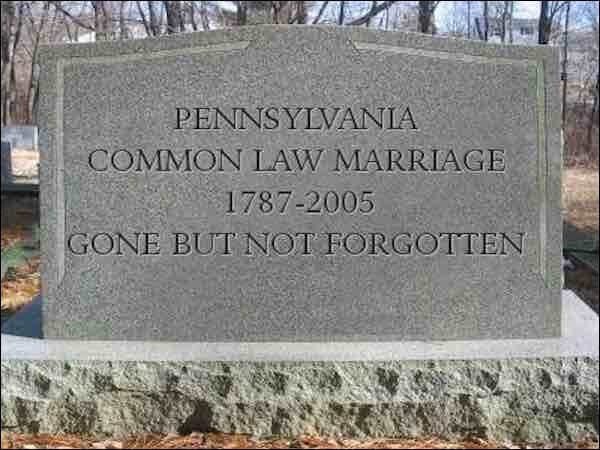
(Note = This paper was presented on October 20, 2003. Since that time, the Pennsylvania Legislature, did in fact, render common law marriage proactively invalid after January 1, 2005, by statute (23 § 1103), stating that “[n]o common-law marriage contracted after January 1, 2005, shall be valid. Nothing in this part shall be deemed or taken to render any common-law marriage otherwise lawful and contracted on or before January 1, 2005, invalid.” (Nov. 23, 2004, P.L.954, No.144, eff. 60 days)).

Philadelphia Pa Common Law Marriage – Intro

Common law marriage in Pennsylvania was recognized by the Pennsylvania Supreme Court over one hundred and thirty (130) years ago. Common law marriage in Pennsylvania was questioned by the Pennsylvania Supreme Court five years ago. Common law marriage in Pennsylvania was abolished by the Pennsylvania Commonwealth Court one month ago?

As a caution, however, it is very important to keep in mind that the Commonwealth Court may not be the final word here. Decisions from this court are always subject to being appealed to – and overruled by – the Pennsylvania Supreme Court, and decisions from this court control only a limited scope of lower courts and administrative agencies (i.e., workers compensation, unemployment compensation, certain taxation issues, etc.).

Philadelphia Pa Common Law Marriage – The Facts

The petitioner filed a fatal claim petition alleging that he was the common law husband of the decedent who had died during the course of her employment.  Because the couple had not been married ceremonially, the facts and circumstances surrounding the nature of their relationship, and the creation – or lack thereof – of their marriage, was the subject of extensive hearings before the Workers Compensation Judge.

Holding that the evidence had proved a valid common law marriage, the Workers Compensation Judge concluded that the petitioner was the common law husband of the decedent. Upon appeal, the Workers Compensation Appeal Board affirmed the Decision of the Judge. Upon further appeal, the Commonwealth Court affirmed the Order of the Appeal Board.

Most notably, and despite a finding of a valid common law marriage in this situation, the Pennsylvania Commonwealth Court abolished common law marriage in Pennsylvania from this point forward.

In a fascinatingly historical and extensively detailed majority opinion, (both factually and legally), as well as an equally well presented, yet briefer, minority opinion, the Commonwealth Court analyzed and reviewed the scenarios and reasons long ago forgotten that gave rise to a doctrine no longer needed.

Philadelphia Pa Common Law Marriage – The Standard

A common law marriage in Pennsylvania can be proven by two different methods. The first, and primary, test is applied when both of the parties are available to testify. This test requires proof of the exchange of words in the present tense – referred to as “verba in praesenti” – which are to be spoken with the specific purpose of creating the legal relationship of husband and wife. The second, and alternative, test is applied when either of the parties is unavailable to testify. This test then allows the creation of a rebuttable presumption in favor of a common law marriage where there is sufficient proof of cohabitation and reputation of marriage in the community.

As is somewhat evident from these tests, and “[b]ecause claims for the existence of a marriage in the absence of a certified ceremonial marriage present a `fruitful source of perjury and fraud’,” Pennsylvania courts have long viewed such claims [of common law marriage] with hostility.

Philadelphia Pa Common Law Marriage – The History

The origins of common law marriage are as varied as the misconceptions held regarding what actually creates one.

Their beginnings have been attributed to the informal marriages prevalent throughout European culture during the pre-Reformation. From there, they have been traced through England, brought to the American colonies during its settlement by the English immigrants, and then followed across the United States during its development, where they continued their existence out of necessity due to the lack of access to clergy.

Waves to abolish common law marriage began in the late 19th and early 20th centuries.

Some of the many and varied reasons cited in support of its abolishment included the growing emphasis on protecting both the institution of marriage as well as the protection of the increased wealth of the average citizen.

These trends continued throughout the 20th century, rising again amidst the creation of the many new governmental benefit programs in the latter part of the 20th century. New Jersey abolished common law marriage by statute in 1955, and, in support of its abolition, the New Jersey Supreme Court stated that “[i]t was not without reason that our statute and similar statutes in other states have been popularly referred to as `Heart Balm Acts.” The many abuses arising from common law marriages, with their effect on public morality, private property rights and the legitimacy of children, called for correction. Our Legislature dealt with such mischief in this act in sweeping and emphatic language, permitting no exception or evasion.  “Despite its judicial acceptance in many states, the doctrine of common law marriage is generally frowned on in this country, even in some of the states that have accepted it.” Accordingly, such a status is the product of an antiquated law and inattention to whether there is a need for change.

Philadelphia Pa Common Law Marriage – The Criticism

However, despite these waves of change, Pennsylvania remains in the minority, being only one of twelve states that still recognizes common law marriage.  Because of this, disapproval of the doctrine has grown harsher and more prevalent, with one of the major areas of concern being that of estate law. It has been opined that “[common law marriage] puts in doubt the certainty of the rights of inheritance,” “opens the door to the imposition on estates of suppositious heirs,” and “allow[s] unprincipled claimants to convert illicit relationships into honest marriages, to their advantage, on spurious claims … against the estate of a decedent.”

In 1998, the Pennsylvania Supreme Court, in the case of Staudenmayer v. Staudenmayer, implied that it was time to abolish common law marriages in this Commonwealth. The Court noted that Pennsylvania courts have long viewed such claims with hostility, warned that the “continued viability [of common law marriages in Pennsylvania] is seriously in question,” but stopped short of abolishing them, concluding that “[w]hile we do not today abolish common law marriages in Pennsylvania, we affirm that claims for this type of marriage are disfavored.”

However, and unlike Staudenmayer, where the issue to abolish common law marriage was not raised on appeal, the issue was properly raised in PNC Bank Corp. In light of this distinction, the PNC Bank Corp. Court noted that “the parties have preserved and fully argued the issue, so it is squarely presented for our consideration, “and stated that “[m]any sound reasons exist to abandon a system that allows the determination of important rights to rest on evidence fraught with inconsistencies, ambiguities, and vagaries. The circumstances creating a need for the doctrine are not present in today’s society.”

The Court cited many reasons in support of its holding to abolish common law marriages in Pennsylvania. These reasons included the fact that “the marital status of parents no longer determines the inheritance rights of their children,” and “the right of a single parent to obtain child support is no longer dependent upon his or her marital status.”

The PNC Bank Corp Court prefaced its holding by stating that “[a]lthough our Supreme Court, while declining to reach the issue [in Staudenmayer], “has raised the overruling axe so high that its falling is just about as certain as the changing of the seasons,” concluded its holding by stating that “[a]ccordingly henceforth, this court will recognize as valid only those Pennsylvania marriages entered into pursuant to the Marriage Law procedures.”

Philadelphia Pa Common Law Marriage – The Conclusion

As its existence in Pennsylvania grows increasingly precarious, it does appear that the door to the church of common law marriage in Pennsylvania may be closing forever.  In light of this decision, when our clients say that they are married, do we still take their word for it?

Philadelphia Pa Probate Lawyers Attorneys Guide

The Philadelphia Pa Probate Lawyers Attorneys Guide is the core of this website. It consists of the best, most important articles on this website. Their focus is to provide the best and most complete information on a particular topic, rather than to sell products.

Related Posts

  • Philadelphia Pa Probate Lawyers Attorneys Guide
  • Philadelphia Pa Living Wills Lawyers
  • 2011 Top One Percent
  • 2010 Awesome Attorneys
  • 2015 Awesome Attorneys

John B. Whalen, Jr., JD., LL.M., is an AV Peer Review Rated Preeminent 5.0 and Avvo Rated 10.0 Superb (obtaining over 95 client reviews and peer endorsements) premier and prestigious Attorney and Counselor at Law. He is located at 8 Longwood Drive Wayne Pa 19087. He serves all surrounding counties, on all 7 days, from 9:00 AM to 10:00 PM, and on evenings, weekends, and holidays. He provides free initial consults all seven days, provides home visits, and provides flat fee structures. He can be reached by email at jw60297@me.com, and by telephone at 1-610-999-2157. He has amassed over 60 prestigious and premier professional awards and over 5000 client reviews and endorsements. Mr. Whalen has achieved the AV Peer Review Rated Preeminent award from Martindale, AV Peer Judicial Preeminent award, the Avvo Rated Superb 10.00 award, the Avvo Rated Top Lawyer award, the Clients’ Choice Award, and the Top One Percent (1%) award. He is the recipient of the Legum Magister Post-Doctorate Degree (LL.M.) in Taxation (from the Villanova University School of Law), a recipient of the American Jurisprudence Award in Wills, Trusts, and Estates (from the Widener University School of Law), and a recipient of the ABA-BNA Law Award for Academic Excellence (from the Widener University School of Law).

Philadelphia Pa HIPAA Powers of Attorneys

wayne-pa-powers-attormey-hipaa

Philadelphia Pa HIPAA Powers of Attorneys – Intro

HIPAA is vast.

Congress enacted The Health Insurance Portability and Accountability Act of 1996 (“HIPAA”) on August 21, 1996. The Health Insurance Portability and Accountability Act of 1996 (HIPAA) is enormous and complex.

Critical Concerns

One of its critical concerns was protecting the privacy of the average American citizen. Prior to HIPAA’s enactment, medical records had become increasingly accessible as a result of technological advances that contributed widespread information sharing.

HIPAA targeted the potential for fraudulent or improper disclosure and transmission of medical records. In doing so HIPAA has created a challenge for lawyers in Pennsylvania who seek to protect the rights of clients who need to exercise Powers of Attorney for their loved ones within the HIPAA environment.

The Privacy Rules – Before

One of HIPAA’s requirements was the establishment of the Privacy Rules.

Prior to the HIPAA Privacy Rules (which were enacted in their current form on August 14, 2002), there was a confusing mélange of federal and state laws to govern the transmission of, and access to, health information.

Under these pre-existing laws, an individual’s health information could be shared freely between doctors, hospitals, insurers, and third party payers, without either notice to, or authorization from, the individual.

The Privacy Rules – After

Consequently, the HIPAA Privacy Rules set federal minimum standards for the disclosure of an individual’s private health information.  The rules attempt to strike a balance between the necessary disclosures of health care information and the privacy interests of those who seek medical care.

Given that the health care marketplace is diverse, the rules are designed to be flexible and comprehensive to cover the variety of uses and disclosures that need to be addressed.

Powers of Attorney

A Pa Power of Attorney is a document that convey legal authority (to the Pa Principal) to act in the name of another person (Pa Agent) for his or her health and welfare.

Historically, health care providers have accepted Powers of Attorney readily, without questioning their validity.

In the post-HIPAA world, however, one can expect a higher level of scrutiny. In fact, the HIPAA Privacy Rules can potentially create a conflict with respect to the traditional language of Powers of Attorney. Thus, to be effective, Powers of Attorney should be drafted to comply with the requirements of the Privacy Rules.

The Privacy Rules protect all individually identifiable health information (defined as Protected Health Information or PHI) of an individual held or transmitted by covered entities (defined as health care providers who transmit any health information in electronic form).

Although the Privacy Rules allow certain uses and disclosures of such information without the consent of the Individual or that Individual’s Personal Representative (defined as a person who has the present authority to make health care decisions for that Individual), the HIPAA Privacy Rules, with few exceptions, proscribe the disclosure of PHI unless the Individual or the Personal Representative authorizes it in writing.

The Granting of Authority

Pa Powers of Attorney are designed to allow an individual the ability to grant authority to another in order to allow the Pa Agent to act on behalf of the Principal.

They can be drafted to be effective now (current powers) or effective in the future occurrence of a specific event (springing powers).

Pennsylvania law (20 Pa.C.S. § 5602(h) and (i)) allows the Principal under the Power of Attorney to grant the Agent the power to authorize “my admission to a medical, nursing, residential or similar facility and to enter into agreements for my care and the power to authorize medical and surgical procedures.”

While Powers of Attorney can be drafted to provide for a wide variety of situations, this article is limited to the impact that the Privacy Rules have on General Durable Powers of Attorney that are presently effective.

If a Power of Attorney grants the Agent the present ability to make health care decisions on behalf of the Principal, the Agent qualifies as the Personal Representative under the HIPAA Privacy Rules.

However, if a Power of Attorney does not grant the Agent the present ability to make health care decisions on behalf of the Principal to the Agent, the Agent is not considered the Personal Representative under the HIPAA Privacy Rules, regardless of the scope of the health and medical authority otherwise granted to the Agent.

In order to be effective under HIPAA, the specific authority granted to the Personal Representative (Agent) under the state defined Power of Attorney rules thus must be consistent with the definition of Personal Representative under the federally defined HIPAA Privacy Rules.

Under the Privacy Rules, a Power of Attorney that is intended to allow the Personal Representative (Pa Agent) the power to access medical records, to authorize information disclosures, and to participate in medical decisions on behalf of the Principal, but not drafted to allow the Personal Representative (Agent) the presently effective power to make health care decisions on behalf of the Principal, may be technically deficient.

Consequently, the Pa Agent may lack the critical necessary powers to act on behalf of the Principal in time of need.

Although some health care professionals may rely upon a Power of Attorney that is not drafted to comply with the Privacy Rules, they do so at their own peril.

The Effective Clause

To address this issue of presently effective powers, I use the following clause in clients’ Durable General Powers of Attorney, as well as in Advance Directives for Health Care:

“to have and utilize the presently effective power and authority to act in accordance with and pursuant to the Health Insurance Portability and Accountability Act of 1996 (HIPAA), its attendant Privacy Rules, 45 CFR Part 164, and/or other federal and state legislation, by having the presently effective power and authority to make any and all health care decisions on my behalf; to give informed consent for any and all health care decisions on my behalf; to be deemed to be my Personal Representative; to act in any and all matters as my Personal Representative; to obtain any and all of my Protected Health Information; to consent to the disclosure and use of any and all of my Protected Health Information; and to have the presently effective power and authority to effectuate any and all of the above.”

Please remember that this article is limited to the impact that the HIPAA Privacy Rules have on General Durable Powers of Attorney that are presently effective.

In light of the fact that the determination of capacity is central to the effectiveness of a Pa Power of Attorney (as well as to many other legal documents), the HIPAA Privacy Rules should not create problems for health care purposes if the Pa Agent possesses the presently effective ability to make health care decisions on behalf of a Pa Principal.  With a properly drafted Pa Power of Attorney, if the Principal becomes incapacitated, the authority of the Agent is not interrupted.

Conversely, the authority of the Pa Agent will be interrupted if the Pa Power of Attorney is not presently effective and a determination of capacity is required to be made.  This situation exists, for example, when an Pa Agent is to act under a Springing Power of Attorney or when a Successor Trustee is to act under a Trust Agreement.

As these scenarios are outside the realm of this article, I would suggest referring to the article, HIPAA-POA: The Effect on Healthcare Power of Attorney by Stephen H. Frishberg, Esquire. This article is contained in the PBI Publication No. 2004-3355, 11th Annual Estate Law Institute.

Stay ahead of the HIPAA Privacy Rules

Estate planners must stay ahead of the basic definitions and tenets of the HIPAA Privacy Rules.

Knowledge of the precise meanings of Protected Health Information, Personal Representative, and other HIPAA terms, and how they impact our practice are fundamental to our role as counselors.

A Power of Attorney is a highly effective document when drafted correctly.

Only with the proper wording in light of HIPAA, the Privacy Rules, and the changing practice of today’s health care profession, will the Power of Attorney remain the powerful tool it is mean to be.

Related Posts

  • Philadelphia Pa USA PATRIOT Act Privacy Rules
  • Philadelphia Pa Probate Lawyers Attorneys Guide
  • Philadelphia Pa Powers of Attorney Lawyers

John B. Whalen, Jr., JD., LL.M., is an AV Peer Review Rated Preeminent 5.0 and Avvo Rated 10.0 Superb (obtaining over 95 client reviews and peer endorsements) premier and prestigious Attorney and Counselor at Law. He is located at 8 Longwood Drive Wayne Pa 19087. He serves all surrounding counties, on all 7 days, from 9:00 AM to 10:00 PM, and on evenings, weekends, and holidays. He provides free initial consults all seven days, provides home visits, and provides flat fee structures. He can be reached by email at jw60297@me.com, and by telephone at 1-610-999-2157. He has amassed over 60 prestigious and premier professional awards and over 5000 client reviews and endorsements. Mr. Whalen has achieved the AV Peer Review Rated Preeminent award from Martindale, AV Peer Judicial Preeminent award, the Avvo Rated Superb 10.00 award, the Avvo Rated Top Lawyer award, the Clients’ Choice Award, and the Top One Percent (1%) award. He is the recipient of the Legum Magister Post-Doctorate Degree (LL.M.) in Taxation (from the Villanova University School of Law), a recipient of the American Jurisprudence Award in Wills, Trusts, and Estates (from the Widener University School of Law), and a recipient of the ABA-BNA Law Award for Academic Excellence (from the Widener University School of Law).

Wynnewood Pa Probate Attorneys

serving-wynnewood-pa-probate-lawyers-attorneys

Wynnewood Pa Probate Attorneys – Bio

John B. Whalen Jr Esq
Wynnewood Pa Probate Attorneys
50 E Wynnewood Rd #22, Wynnewood, PA 19096

Wynnewood Pa Probate Attorneys – Profile

John B. Whalen, Jr., JD., LL.M., is an AV Peer Review Rated Preeminent 5.0 and Avvo Rated 10.0 Superb (obtaining over 95 client reviews and peer endorsements) premier and prestigious Attorney and Counselor at Law. He is located at 8 Longwood Drive Wayne Pa 19087. He serves all surrounding counties, on all 7 days, from 9:00 AM to 10:00 PM, and on evenings, weekends, and holidays. He can be reached by email at jw60297@me.com, and by telephone at 1-610-999-2157.

Mr. Whalen has amassed over 60 prestigious and premier professional awards and over 5000 client reviews and endorsements. Mr. Whalen has achieved the AV Peer Review Rated Preeminent award from Martindale, AV Peer Judicial Preeminent award, the Avvo Rated Superb 10.00 award, the Avvo Rated Top Lawyer award, the Clients’ Choice Award, and the Top One Percent (1%) award. Mr. Whalen is the recipient of the Legum Magister Post-Doctorate Degree (LL.M.) in Taxation (from the Villanova University School of Law), a recipient of the American Jurisprudence Award in Wills, Trusts, and Estates (from the Widener University School of Law), and a recipient of the ABA-BNA Law Award for Academic Excellence (from the Widener University School of Law).

Wynnewood Pa Probate Attorneys – Hours

Wynnewood Pa Probate Attorneys – Video

Wynnewood Pa Probate Attorneys – Review

The best gift you can give your loved ones is to have your Estate Planning complete. Unfortunately, to a great extent, misinformation about critical terms such as Pa Inheritance Tax, Federal Estate tax, Pa Probate, avoiding probate, simple will, Pa Living Will, and Pa Living Trust, tends to lead to misunderstandings of estate planning.

  • Berwyn Pa Probate Attorneys
  • Devon Pa Probate Attorneys
  • Exton Pa Probate Attorneys
  • Gladwyne Pa Probate Attorneys
  • Haverford Pa Probate Attorneys
  • Narberth Pa Probate Attorneys
  • Paoli Pa Probate Attorneys
  • Phoenixville Pa Probate Attorneys
  • Radnor Pa Probate Attorneys
  • Villanova Pa Probate Attorneys
  • Philadelphia Pa Probate Lawyers Attorneys
  • Wynnewood Pa Probate Attorneys

Practice Areas

Philadelphia Pa Beneficiary Lawyers

There are many factors that can affect the distribution of estate assets.

Sometimes there may be a Pa Will.

However, in other cases, there may not be a Pa Will at all.

Sometimes there may be a dispute involving the administration of the estate.

For example, a beneficiary may disagree with how the Pa Executor is distributing assets.

Philadelphia Pa Estate Administration Lawyers

Pa Estate Administration is the process of settling a decedent’s affairs.

When a loved one passes away, it can be an emotional time.

In addition to grieving, the survivors must tie up all the legal and financial loose ends.

This includes addressing their Pa Last Will and following its instructions.

Philadelphia Pa Estate Lawyers

In this paragraph, I want to explain that Pa Estate law has many areas of law.

However, all of these areas of law focus on taking care of one’s person and property.

Pa Estate Law involves all of the things that impact how a person makes decisions about their affairs.

Simply stated, an estate is what a person has in their own name alone when they die.

Philadelphia Pa Estate Litigation Lawyers

Generally, most PA Estates are easily settled.

Yet there are times when other factors complicate the issue, which would require more careful consideration.

For example, a family business that holds significant amounts of real estate may become complicated quite quickly.

Thus, estate litigation may come into play.

Philadelphia Pa Estate Planning Lawyers

A Pa Estate Planning attorney can help you create a complete Pa Estate plan.

A Pa Estate plan may include one of many documents. These a Pa Last Will, a Pa Power of Attorney, and a Pa “Living Will.”

Taken together, these documents comprise your Pa Estate plan.

It will protect your spouse and children if you become unable to manage your affairs.

Philadelphia Pa Powers of Attorney Lawyers

A Pa Power of Attorney authorizes another individual to make certain decisions on your behalf.

The Pa Principal signs the document – the Pa Agent accepts the document.

Philadelphia Pa Living Wills Lawyers

“Pa Living Wills” (Pa Advance Directive for Health Care) grants your Pa Surrogate the ability to enforce your end-of-life decisions.

Therefore, should you become unable to speak for yourself, your “Pa Living Will” will explain your desires with you medical treatment.

Philadelphia Pa Trusts Lawyers

Trusts are legal documents that allow you to control how your assets will be allocated or managed.

You are considered the grantor and the person that manages and distributes assets in the trust is known as the trustee.

You can also create a revocable trust. This would allow you to cancel or revoke it at any time.

Trusts can be set up for a child’s education or to reduce Federal Estate taxes.

Philadelphia Pa Last Wills Lawyers

A Pennsylvania Last Will is a very important document. It dictates how your assets will be divided when you die.

The Pa Executor administers assets from your estate. He or she will allocate your possessions as you specified.

You should periodically review your Pa Will to make sure it is still relevant and accurate.

Life changing events, such as the birth of a child or a marriage, may require amendments.

Philadelphia Pa Estate Litigation Lawyers

Most estates, especially when there is a proper Pa Will, are easily settled.

Yet there are times when other factors complicate the issue. This then creates a situation that requires more careful consideration.

As examples, a family business, an estate that is in bankruptcy or an estate that holds significant amounts of real estate may cause a Pa Estate to complicate quickly.

Philadelphia Pa Estate Taxation Lawyers

A Pa Executor of a Pa Last Will or a Pa Trustee of a Pa Trust has a fiduciary duty.

The financial assets of another person or entity, they have the responsibility of keeping accurate financial records.

The records should show how your money was handled while the fiduciary was in care control.

Therefore, a proper accounting can bring to light the wrongs should an issue arise with an interested party.

Philadelphia Pa Guardianships Lawyers

Human emotions run through the Pa Guardianship process.

Thus, realizing that someone is now incapable of caring for themselves can be difficult to accept.

Philadelphia Pa Probate Lawyers Law Lawyers

The Pa Probate process, itself, is a very simple process.

However, it is merely the beginning of the Pa Estate Administration process.

It consists of settling all of a decedent’s affairs.

Therefore, it can (and does) involve many other things to do.

Philadelphia Pa Probate Lawyers Attorneys Guide

The Doylestown Pa Probate Attorneys Guide is the core of this website.

It consists of the best, most important articles on this website.

Their focus is to provide the best and most complete information on a particular topic.

Therefore, the Guide is not intended to sell products.

He concentrates his three decade career in the legal areas Pa Probate,Pa Estate Planning including Pa Last Wills, Pa Powers of Attorney, Pa Living Wills), Pa Estate Administration, Pa Estate Taxation, Pa Estate Litigation, Pa Beneficiary Representation, and Pa Guardianships.

John B. Whalen, Jr. Esq. sees your case through from start to finish. Let me work with you to address your legal concerns. My offices are conveniently located in Philadelphia. Call the firm at 610-999-2157 to arrange your consultation or contact the firm online.

Related Posts

  • Wynnewood Pa Probate Attorneys
  • Philadelphia Pa Probate Lawyers Attorneys
  • Philadelphia Pa Probate Lawyers Attorneys
  • Philadelphia Pa Estates
  • What Is A Philadelphia Pa Last Will?

John B. Whalen, Jr., JD., LL.M., is an AV Peer Review Rated Preeminent 5.0 and Avvo Rated 10.0 Superb (obtaining over 95 client reviews and peer endorsements) premier and prestigious Attorney and Counselor at Law.

Mr. Whalen is featured on AV Peer Review Rated Preeminent 5.0, Avvo Rated 10.0 Superb, Avvo, Justia, Lawyers, Martindale, Nolo, Quora, and Thumbtack.

John is located at 8 Longwood Drive Wayne Pa 19087. He serves all surrounding counties, on all 7 days, from 9:00 AM to 10:00 PM, and on evenings, weekends, and holidays.
Mr. Whalen provides free initial consults all seven days, provides home visits, and provides flat fee structures. He can be reached by email at jw60297@me.com, and by telephone at 1-610-999-2157.

John has amassed over 60 prestigious and premier professional awards and over 5000 client reviews and endorsements. Mr. Whalen has achieved the AV Peer Review Rated Preeminent award from Martindale, AV Peer Judicial Preeminent award, the Avvo Rated Superb 10.00 award, the Avvo Rated Top Lawyer award, the Clients’ Choice Award, and the Top One Percent (1%) award.

He is the recipient of the Legum Magister Post-Doctorate Degree (LL.M.) in Taxation (from the Villanova University School of Law), a recipient of the American Jurisprudence Award in Wills, Trusts, and Estates (from the Widener University School of Law), and a recipient of the ABA-BNA Law Award for Academic Excellence (from the Widener University School of Law).

  • « Go to Previous Page
  • Page 1
  • Interim pages omitted …
  • Page 108
  • Page 109
  • Page 110
  • Page 111
  • Go to Next Page »
  • Home
  • Areas
  • Archives
  • Contact

• Ancillary Probate Philadelphia Pa • Deed Lawyers Philadelphia Pa • Deed Transfers Philadelphia Pa • Deeds Philadelphia Pa • Estate Attorneys Philadelphia Pa • Estate Lawyers Philadelphia Pa • Estate Settlement Philadelphia Pa • Estate Tax Lawyers Philadelphia Pa • Executor Lawyers Philadelphia Pa • Inheritance Tax Philadelphia Pa • Inheritance Taxes Philadelphia Pa • Letters Testamentary Philadelphia Pa • Out-of-State Executors Philadelphia Pa • Philadelphia Pa Ancillary Probate • Philadelphia Pa Short Certificates • Power of Attorney Philadelphia Pa • Powers of Attorney Philadelphia Pa • Probate Philadelphia Pa • Probate Law Philadelphia Pa • Probate Law Firms Philadelphia Pa • Probate Lawyers Philadelphia Pa • Small Estate Lawyers Philadelphia Pa • Short Certificates Philadelphia Pa • Short Certificate Lawyers Philadelphia Pa • Wills Lawyers Philadelphia Pa •

Copyright © 2026